Arsenic and Biomalz
It is well documented that as early as the beginning of the twentieth century, doctors were conducting experiments on bicycle racers and did not shy away from administering arsenic, antipyrine, phenacetin, and pyramidone. In 1919, Fredy Budzinski wrote the following in an article addressing the issue:
"It cannot be denied that in the early American six-day races, repeated attempts were made to compensate for a lack of training and experience with stimulants. (...) Our racers have long since realized that diligent training is the best ‘doping’ for them, and six-day racers in particular are wary of strong stimulants, as they know full well that the reaction will not be long in coming.”
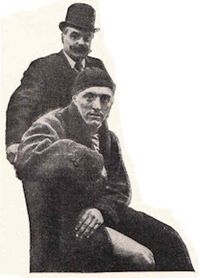
Walter Rutt, 23, showing the effects of the grueling 1906 Six-Day Race in New York
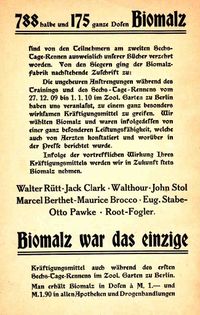
The manufacturers of sports nutrition products, acting as sponsors, naturally jumped at the chance to use the extraordinary achievements of the six-day racers and their popularity to promote their products. The text of this advertisement reads
According to our records, participants in the second Six-Day Race consumed 788 half-cans and 175 full cans of Biomalz. The Biomalz factory received the following letter from the winners:
“The tremendous exertions during training and the Six-Day Race from December 27, 2009, to January 1, 2010, at the Zoological Garden in Berlin led us to turn to a particularly effective tonic. We chose Biomalz and, as a result, experienced exceptional performance, which was also noted by doctors and reported in the press.
Due to the excellent effects of your tonic, we will always use Biomalz in the future.”
Biomalz was the only tonic used during the first Six-Day Race at the Berlin Zoological Garden as well. Biomalz is available in cans priced at 1 mark and 1.90 marks at all pharmacies and drugstores.