The 2nd Berlin Six-Day Race
By Fredy Budzinski
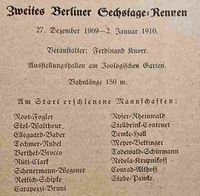
"Berlin champion cyclist Arthur Heimann gave the signal for the start of the race. Rutt's return to Germany and his participation with Clark as his partner dominated the race. In the fourth hour, Tadewald-Ryser, Carapezzi-Bruni, Conrad-Uthoff, Nedela-Krupnikoff, and Schipke-Rettich were pushed out of the leading group. In the fifth hour, Bruni crashed out of the race. Tadewald suffered a broken collarbone and Ryser rode with Carapezzi.
Otto Meyer and Rettich dropped out in the 24th hour. Bettinger and Schipke formed a new team. Techmer and Bader gave up the race in the 29th hour. Ellegaard and Rudel were entered into the race as a new team with a 1-lap deficit. In the 49th hour, a duel between Theile and Kudela took place during the race, which Theile won easily."
"In the 68th hour, Berthet-Brocco won a lap but immediately lost the lead again. Contenet-Stellbrink and Scheuermann-Wegener were pushed out of the leading group in the 68th hour. In the 70th hour, Krupnikoff dropped out. Nedela-Techmer became the new team.
Ellegaard gave up in the 71st hour. Rudel formed a new team with Bader, who was back in the race. Techmer and Nedela fell far behind and were pulled out of the race. In the 73rd hour, a duel between Arend and Poulain came to a head. Arend won the first and third runs and beat the Frenchman by 4 points.
In the 74th hour, Theile beat Kudela in a chase race. In the 77th hour, Ryser gave up and Nedela, who had already been withdrawn from the race, was readmitted to form a team with Carapezzi."
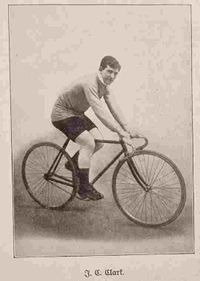
"On New Year's Eve 1909/1910, Nedela-Carapezzi and Conrad-Althoff dropped out. Poulain beat Arend in the race for revenge. In the 104th hour, Wegener dropped out. Scheuermann continued as a substitute. In the 112th hour, the crown prince appeared in the hall. In the 107th hour, Berthet-Brocco and Stabe-Pawke were pushed out of the leading group and all other teams were lapped several times by the teams Rutt-Clark, Root-Fogler, and Stol-Walthour.
Hall-Demke dropped out in the 108th hour and Bettinger-Schipke gave up in the 110th hour. In the 114th hour, the Crown Prince appeared in the hall and the Rütt-Clark team overtook the field. Bader-Rudel gave up in the 118th hour. In the 143rd hour, Robl presented his compatriot Rutt with the world champion jersey. The race ended without any further laps. Stol beat Brocco in the battle for second place by half a lap."
Result
- Rutt-Clark 3753,15 km
- Stol-Walthour 1 lap
- Brocco-Berthet 1,5 laps
- Stabe-Pawke 3 laps
- Root-Fogler 6 laps
- Stellbrink-Contenet 12 laps
Walter Rutt's impressions of the race
"I experienced so much in the days before and after the race that I am still unable to make sense of it all. In the last days of December 1909 and the first days of January 1910, my fate was sealed. I was granted the privilege of returning to my homeland, I heard the cheers that my appearance at the velodrome in the zoo elicited, I won the Berlin Six-Day Race, I rediscovered my homeland. How difficult it is to concentrate one's thoughts on a single point under the impression of such an accumulation of overwhelming events, but I will try and put my impressions during the race down on paper."
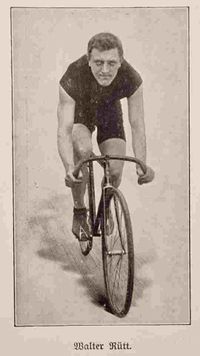
"When I realized that my long-cherished wish to compete in a six-day race in front of my compatriots was about to come true, I had only one thought: to win at any cost. I was surprised by the news in Le Havre that I would be allowed to come to Germany, learned all the details in Verviers, and was greeted in Berlin with cheers that I will never forget. All of this, combined with the aftermath of the six-day race in New York that had ended just a few days earlier, made me a little nervous and caused me to have slight doubts about winning the Berlin six-day race, but I fought those doubts down and, trusting in my partner Clark and my energy, I went into the race knowing that it was not just a matter of honor and money, but of being or not being.
The welcome in the hall at the zoo gave me courage. I went into the race with the best intention of going all in, and on the very first day I realized that my chances were good. My partner Clark was just as capable as I was in every situation, and on the second day we dominated the field. We thought about winning a lap every hour, but we had to learn that there were excellent racers among our opponents who would not tolerate being lapped. We were prepared for a tough fight, but we knew that if we did a good job, we would be as successful as we had been in the six-day race in New York.
On the third and fourth days, I began to feel the after-effects of the New York race. I was familiar with this state of fatigue, and with the help of my managers, I was able to overcome it easily. A critical moment for me was when Clark fell ill with a leg ulcer, but when I learned that the minor operation had been successful, I continued the race with even greater enthusiasm and love. I kept myself together, because I was expecting the crown prince to visit at any moment. Only in the presence of the heir to the throne did I want to give my all and prove that, despite all the hardships of the past few weeks, I was still at full strength.
When the crown prince appeared, I was resting, but I had never been awakened so quickly from this sleep. I quickly changed my clothes and rushed to the track. My opponents knew that the moment of decision had come, and I was aware that a tough battle was about to unfold. I sprinted lap after lap and my partner Clark supported me very bravely, but unfortunately we were not able to take a lap in front of the Crown Prince. It was only after the Crown Prince had long since left the hall that we managed to conquer a lap.
With this lap advantage, we had won the race, barring any accidents. We did not underestimate our opponents in any way and saw Stol, Walthour, Stabe, and Brocco as our fiercest rivals, but this did not shake our confidence in ultimate victory. The last two days were not easy for me, but I fought with all my might. I didn't lose heart, even when my brave partner suffered what at first looked like a dangerous bout of weakness on the last day. But Clark recovered very quickly and we won the race, which was so precious to me.
Never in my life have I felt such satisfaction as after winning the Berlin Six-Day Race, and I will never forget the ovations we received during the lap of honor.
If I may say a few words about the track and my opponents, I would like to note that the track was very disadvantageous for me due to its sharp curves. I felt handicapped, but I didn't let any of my opponents notice and silently accepted the sliding of my rear wheel during sharp sprints. I never dared to pedal with all my might, but what I gave was enough to win, and I will not hold a grudge against the track despite its unfriendliness towards me.
The track was well suited to smaller and lighter riders such as Stol, Pawke, and Brocco, and I feared my opponents greatly for this reason. I knew what Walthour, Stol, Root, and Fogler were capable of. What surprised me most was the good form of Stabe and Pawke, and I have no hesitation in giving the two Berliners a first chance with the kind of catering enjoyed by the top teams in a six-day race."