The Berlin Six-Day Race 1911
By Walter Rütt
With feelings very different from those I had in 1910, I am now responding to the request to describe my impressions of the six-day race, because while I was still under the impression of my return to Germany, which was fraught with many difficulties, this time I competed in the six-day race as a free man. However, this time too, I did not reach the start without a serious inner struggle, because I was faced with the question of either disregarding my health completely or handing the Six Day Race over to the foreigners.
I knew what was at stake for me if I entered the long race and did not expect the audience to be lenient, but on the other hand, my legs trembled when I learned the names of the riders who were to be entered for the long race. I thought about it for a long time and kept remembering what the author of this brochure had said to me before the Dresden Six-Day Race, because rarely in my life has a prophecy come true as surely as in this case.
The same Mr. Budzinski who had said to Stol and me before the Dresden Six-Day Race: “I don't want to advise you one way or the other, but I'm telling you that something is going to happen and you will remember my words often,” called me on the phone to find out my decision while I was in Rheydt with my parents, waiting for my collarbone, which I had broken in Dresden, to heal. I declined, but Mr. Budzinski managed to throw all my plans into disarray and persuade me to accept the terms of the contract, which Director Hölscher informed me of by telephone immediately afterwards. I must say that I did not feel very comfortable when I gave my consent, because my broken collarbone was still causing me pain and I did not believe that it would heal so quickly.
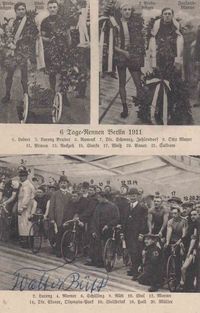
Photo: Franz Martin, Leipzig
Postcard from the 1911 Berlin Six-Day Race
In any case, I couldn't stay at my parents' house any longer, and driven by an inner restlessness, I traveled back to Berlin with my wife and son. My first stop was Dr. Willner, who gave my shoulder a thorough check and promised me the fastest healing possible with his own method. Dr. Willner gave me an iodine injection that made me hear all the angels in heaven whistling, but I have to admit that the injection worked wonders. I could move my arm and ride my bike to the sports palace without any discomfort or pain.
The next day, I rode my bike to the Zehlendorf velodrome and trained there with Otto Meyer. I felt very refreshed and was so pleased with my form that I looked forward to the six-day race with great confidence in my ability. When the track was set up, I no longer thought about my broken collarbone, and after riding the first few laps on the unfamiliar track, I felt just as fresh as before my fall.
As long as I didn't have any problems with my injury, my chances were very good, because I really only had three teams to fear in the race. These three teams were McFarland-Moran, Saldow-Lorenz, and Stabe-Pawke. I knew what to expect from the Americans, because I knew Mac Farland, with whom I had ridden my first six-day race in 1906, and I also knew Moran, but I didn't know exactly what to expect from Lorenz and Saldow in a fiercely contested race.
I had seen Lorenz ride with Demke in Hamburg and with Saldow in Dresden, and I knew that the Berliners were good six-day riders, but their knowledge of the tactics of a first-class six-day race was still too limited to make life difficult for us throughout the race. Nevertheless, I took the matter very seriously and counted primarily on the two Berliners, who, in my opinion, could only be beaten by the Americans due to a lack of tactics. I had gotten to know Stabe and Pawke in the second Berlin six-day race and believed that, based on their performance at that time, they deserved a chance. I also saw Schilling as a serious opponent, but I didn't really believe that the Dutchman would be able to endure the long race.
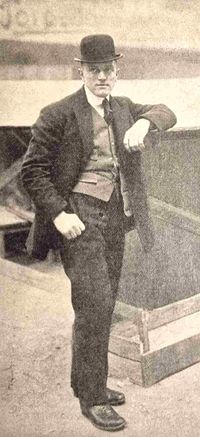
Walter Rutt in civilian clothes
In any case, I went into the race with great confidence in Stols and my own abilities, and waited patiently until I could no longer control myself and set off in the 22nd hour. The success was somewhat unexpected, as the Americans lost a lap and Saldow-Lorenz stayed with us. Our aim now was, of course, to shake off the Berliners in order to take the lead on our own, and we made several attempts to sprint ahead, but always without success.
To my great regret, after a major battle, I learned that I was suspected of colluding with the Americans to shake off Saldow-Lorenz, and I must admit that I have rarely been so deeply offended. I tried everything I could to prove the opposite, but the rumor kept resurfacing. In the end, I didn't know what to do and waited for Saldow-Lorenz to go on the attack.
This attack came in the 96th hour, and I decided that the moment had come to play my first trump card against the Berliners. Stol supported me valiantly, and the two of us gained a round on our own.
When we reached the field, we expected Saldow-Lorenz to join us, but they did not. Instead, the Americans assessed the situation and went along with us. As natural as it was for Stol and me to want to win a lap, and as natural as it was for Mac Farland-Moran to be interested in catching up with Saldow-Lorenz, it was incomprehensible to me that even after this battle, I was told that rumors of a combination with the Americans had resurfaced.
Every rider had the right to attack, and every rider could hang onto our rear wheel.
We merely responded to an attack by Saldow-Lorenz and gained a lap all by ourselves. Once we had built up a sufficient lead, we limited ourselves to holding off our opponents, and everything would have gone smoothly if I hadn't started having stomach problems shortly before the end of the race. I had to leave Stol alone in the race, as a stomach pump was the only way to save me.
I can't describe what I went through during that forced break, and I don't want to think about it anymore. In any case, the last few hours of the race were terrible for me, and I'm glad I didn't have to force myself to get back into the fight despite feeling so bad. I won the race with Stol more easily than I thought I would, but I could have lost it at the last moment if my partner hadn't been so good at his job and spared me at the critical moment.
Note
The article appeared in the brochure “Das dritte Berliner Sechstagerennen” (The Third Berlin Six-Day Race) by Fredy Budzinski. The text has been reproduced without corrections. For reasons of better readability, the number of paragraphs has been increased compared to the original print.
Copyright © 2005 - 2026 Bernd Wagner All rights reserved