Prolog
The birth of track cycling
In the late 19th century, a resourceful mind had the idea of making cycling, which until then had only taken place on the road, accessible to a wider audience. The idea that this person was a representative of the bicycle industry does not seem far-fetched, as people were looking for ways to attractively advertise this means of transportation, which was experiencing a tremendous boom and offered enormous profit margins.
A field of riders on the road passed by quickly, while the riders doing laps on the oval of a racetrack were an eye-catcher that spectators could follow from the starting signal to the end of the race. This was the birth of track cycling, and in no time at all it became one of the most popular sports alongside boxing and horse racing.
Across Euroe, as well as in North America and Australia, velodromes sprang up. Imposing structures were built with magnificent boxes for wealthy spectators and cheap standing room on the grandstands in the curves, but also very simple facilities where the straights consisted of leveled open spaces and embankments replaced the steep curves. Even in buildings that were not really suitable for this purpose, carpenters erected track constructions that sometimes looked rather adventurous.
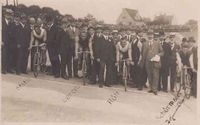
Start of a sprinters match on the cycletrack in Essen
The fastest people in the world
The following pages will focus on the cycle sprinters. In a time without car traffic as we know it today, pure muscle power made them the fastest people in the world. The best of them became professional cyclists and had admirers in all walks of life.
Their competitions were heavily advertised in the press and on posters, and ticket sales began weeks before the races. Fans welcomed visiting riders at the train station, besieged their quarters, and little boys were proud when they were allowed to carry their idols' travel bags to the race track.
Sprinter races were major events, and where the stadiums provided the space, more than 20,000 spectators came, including ladies in their finest dresses and gentlemen in tailor-made suits.
When the sprinters accelerated their racing machines to speeds of over 60 kilometers per hour with powerful moves, the enthusiasm of the audience became totaly nuts. When the American Major Taylor competed against Europe's top sprinters, it was an event that moved the sporting nation.
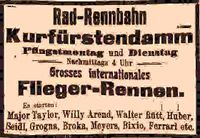
Sprinter races
...has developed into a kind of art form today. The early followers of bicycle racing in Germany had no idea about the intricacies of today's air racing, such as saving energy for the decisive final sprint, battling for position, and surprisingly fast acceleration.
Back then, these demonstrations began right from the start at an energetic pace that was maintained until the end. Like the sport as a whole, the intricacies of cycling competitions came to us from abroad; our riders learned them from the English, Belgians, and Dutch, among others, and from then on they became accustomed to winning races not only with the strength of their legs, but also with their heads.
Illustrierte Zeitung 26. Juli 1906
Six days on the bike
Quite different in nature from the air races, but of equal interest to the public, were the six-day races, which were in no way comparable to those of today. They were real, grueling endurance tests lasting six full days and nights, and they took place under conditions that would be considered unacceptable today.
The races were held in winter, and the unheated halls were often barely warmer than outside, so the riders brought small stoves with them, which they set up near their bunks so they wouldn't “freeze to death” during their short breaks. Next to their bunks, they placed an oxygen apparatus that allowed them to take a few breaths of fresh air from time to time. Tobacco smoke hung in thick clouds over the track, irritating the eyes and making breathing considerably more difficult.
Both the sprinter racers and the six-day racers included some of the absolute best in their respective fields, and it was almost impossible to excel in both disciplines. The protagonist of these pages succeeded in winning both the title of world champion in the flying race and that of champion in the six-day race. His story is one of rise and success, of prestige and wealth, but it is also one of the transience of fame and poverty. It is the story of Walter Rutt.

Presse photo of the 5th. Berlin six-day race
Copyright © 2005 - 2026 Bernd Wagner All rights reserved