The decline of German cycling
By Walter Rutt
There are few greater contrasts than German and French cycling. It is generally accepted that these two nations lead the way in this sport, and since there are probably few experts who are as knowledgeable about both countries in this regard as I am, I believe I am in a position to pass judgment on many points. This should be said up front to justify some of the following attacks on the nature of German cycling.
Cycling experts love to wax lyrical about the good old days. Back then, Willy Arend still had a global reputation and fought sensational races with Ellegaard and Major Taylor, who are still going strong today. There is no doubt that the races back then had a relatively greater appeal than our countless “championships,” “Grand Prix,” “Golden Wheels,” etc. today. The reason for this is obvious.
People may think I am biased, or, since I am a sprinter, a businessman, when I say that the decline of German cycling – and there is no doubt that this is the case – began when motor pacers were introduced to races. This may sound paradoxical, but it is an absolute fact. I can already hear the objection that since motor racing began, tracks have sprung up like mushrooms.
I don't want to deny this fact, on the contrary! I would even emphasize that the spread of motor racing since its introduction has been enormous. This was not growth under normal conditions, it was greenhouse air! But that's not all. Every other misfortune can be repaired, so why couldn't sprinter's races, which had been pushed back by motor racing, be restored to its former glory? However, there was an insurmountable obstacle here, namely the way in which German tracks are laid out.
All tracks in France are designed for motorcycle racing, while all tracks in Germany are designed for car racing. Tracks such as those in Cologne, Dresden, and Leipzig simply do not allow for real motorcycle racing. Just as you will never see motor races in France that are as good as those in Germany, Germany will never get to see the first-class sprinter's races in France, which in my opinion represent the ideal form of cycling.
If you go back to the very beginnings of cycling, you naturally also go back to sprinter's races. Stayers' races behind engines are just an unhealthy variation of the endurance races that used to be common with pacemakers. But let's continue to follow the development, or more accurately, the entanglement of German cycling. Wherever concessions were available, large concrete racetracks sprang up throughout Germany.
There are about 40 cities in Germany with more than 100,000 inhabitants, compared to only about 15 in France. Since stayers race had unfortunately been introduced, all other racetrack owners felt compelled to promote it more, as the public demanded high speeds when the track allowed them. Stayers race was simply more exciting and brought a certain life-threatening element to the competition, which, while thrilling the spectators, increasingly drew them to endurance racing. If sprinter's races were still held, it was more to fill the program and not completely stifle old traditions. The entire German cycling scene developed more and more according to these principles.
Another, far sadder moment that finally allowed sprinter's races to make a comeback on German tracks were the accidents that occurred during stayer races behind engines. I remember very clearly when the first motor races were held and immediately claimed their first human lives. It would probably not be appropriate for me to draw up a list of the many cyclists who lost their lives due to this aberration – or rather, this bad habit – of cycling. It would not be in the interests of cycling, as the layman is inclined to lump everything together. In fact, stayer racing has nothing in common with cycling as a sport.
So I will just mention here that almost all endurance cyclists show very few signs of fatigue after long races behind engines. It's not that they were so well trained or so fabulously gifted – it's impossible to accomplish a truly great sporting achievement in such a way that the body hardly notices it. It follows that stayer races are not of great sporting value in this respect either, because the audience is supposed to go to the racetrack to admire great physical achievements by people who have a rare talent for it! That is what is so admired in sport in the first place!
So what good qualities remain in races behind motor pacers? My answer is as frank as it is brief: none. Apart from being an unhealthy speculation on the nerves of the spectators, stayer races have also been very harmful from other points of view.
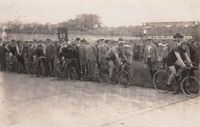
Perhaps it is wrong of me to write so openly here, but I hope that it will benefit cycling, which is truly an ideal sport. Here in Germany, we are currently very much focused on stayer races. For this reason, the many cyclists who start out as sprinters have an extremely difficult life. This applies at least to the vast majority, because of course the big stars who have their permanent commitments are excluded from this statement.
There is tremendous interest in cycling in this country, and it is often idealism that drives a healthy young man who feels so talented that he takes the big risk of giving up his job and putting on a jersey to live off the income from his sporting achievements in the future. And how disappointed most of them become.
I said earlier that there are racetracks everywhere in Germany. That is true, but every management will organize a few competitions behind engines as the main race. However, stayer races completely rule out a larger number of participants than a maximum of five competitors, for various reasons. Firstly, the police would veto allowing more than five cyclists to compete at the same time because of the excessive danger involved, and secondly, the conditions for stayers require such high fees that the racetrack owner has to calculate very carefully if he wants to cover his costs despite a well-attended event.
Stayers, on the other hand, have to carry such a large apparatus around with them that they cannot make it cheaper, even with the best will in the world. Of course, they still earn a disproportionately high income, but this is hardly surprising when you consider that long-distance cyclists risk their lives in every race and every training session (i.e. every day!).
Now one could say to the sprinters: “Go forth and do likewise, become endurance cyclists!” That's easy to say, but first of all, not everyone wants to risk their neck every moment, or they may be gifted with aesthetic sensibilities and have an insurmountable aversion to motor racing. Hence the partial social misery of our cyclists and hence the unfavorable light in which this profession, which is as difficult as it is fair, is viewed. It has even come to the point where one sometimes has to be ashamed to be counted among the cyclists.
The many uncommitted or unsuccessful colleagues have to struggle through as best they can, and the fact that one or the other, who was previously a fairly good and respectable person, does something stupid is, after all, an understandable thing that is not even unique to cycling. Nothing ventured, nothing gained, and you take a risk by resorting to cheating, which only promises rewards if you are better than the others who have also entered the fray with the same desire to win, which for them is a fight for survival. It's a game of va banque, and I don't advise anyone to recklessly throw away their career to pursue dreams in which they already see themselves as famous cyclists.
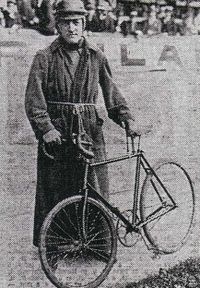
Photo: Illustrierter Radrennsport
Walter Rutt also tried his hand at stayer racing, but it remained a one-time thing.
Now I would like to compare these statements with the conditions of French cycling. I will summarize in advance: they are considerably better. The reason for this is as follows: when cycling began to become popular, many tracks were built in France, even in towns with around 10,000 inhabitants, almost all of which still exist today. These tracks do not allow the abnormal speeds of a race behind engines, and therefore the first attempts made at that time to introduce stayer races there were by no means encouraging.
Of course, we now also have these races in France, albeit only in Paris; its sons are even at the top of international cycling as representatives of stayer races (e.g., Séres Guignard, Parent, Darragon, etc.), but they have had to earn their main laurels outside the tricolor. The fact that sprinter races continued to be popular there is proven by the fact that the subsequent tracks were built exactly according to the old model. I could name 25 tracks where I competed in sprinter races during my four-year absence from Germany, and all of them I consider superior in every respect to tracks such as Cologne, Dresden, etc.
This has had the further welcome consequence that a race track can be built in every small town in France and still be profitable, because sprinters do not have the same demands as stayers with their extensive pacemaker equipment. In this way, cycling has become established in the best sense of the word in every small town in France. For this reason, one hardly ever hears of accidents in French races, and for this reason France has such a large number of outstanding representatives. That is why the social misery of racing cyclists is unknown in France!
Everyone has their ongoing commitments, because the many tracks need to be filled, and even if the races are essentially repeated there, they always find a grateful and well-paying audience, because they see it as real sport, i.e., healthy stimulation. The beautiful final battles that can be seen on French tracks are hardly to be found in Germany. This explains the enthusiasm with which every first-class rider is welcomed over there. Poulain, Friol, and the now deceased Jacquelin are popular personalities in France. The people revere these individuals as the cream of their nation and hold them in high esteem. Here in Germany, cyclists are considered to be of a lower social class.
I am happy to be able to race in Germany again. I am forced to compete against good opponents and—since the track operator has to make money—he cannot afford to offer as many prizes and fees for stayer races. I don't want to rule out stayer races altogether.
That would be the most important thing to write about the reason for the decline in German cycling that has been noticeable for some time now. The fact that this decline is indeed real is evident from the fact that, for example, two velodromes in Berlin were demolished last year and the other two are no longer as busy as they used to be. This is a radical change that never takes place without accompanying circumstances. I have no doubt that these circumstances may be somewhat painful for the track owners, but I believe I can hope that the change will lead to a recovery in German cycling and that true cycling will gradually come back into its own.
This would be desirable not only in the interests of track owners and cyclists, but also in the interests of the entire German people, who are being degenerated by the still-predominant equestrian sport, from which they can never profit. If my words can help in any way, I will not regret having taken up my pen.
Note:
The article appeared in 1910 in the magazine “Zeit im Bild,” issue 25.