Six-day figures
By Walter Rutt
If I hadn't preferred to move into sports management after my 25-year racing career, I could have competed in and celebrated my 25th six-day race this winter. The Australians Goullet and Mac Namara, who continued to flourish in the “Six Days” in America during the war, have completed a far greater number of six-day races; the Swiss Egg already has 26 under his belt, and the little Frenchman Brocco, who, incidentally, is always passed off as Italian in America to accommodate the huge Italian colony in New York, has even managed 35.
In my 24 six-day races, I have of course experienced and seen many things and been able to think about many things that the simple spectator would hardly think about. There are many interesting things going on behind the scenes of a six-day race, and I want to tell you about some of them here, but mainly numbers. Numbers always have a somewhat dry quality, but my “six-day numbers” make up for that in part with their astonishing nature. In addition, six-day races have become an economic factor these days, providing employment and income not only for racers and entrepreneurs, but also for many industries, retailers, and the transportation sector.
Now let's move on to the actual protagonists, the cyclists. Let's assume that the race is contested by 14 teams, i.e., 28 cyclists. Each of them needs two carers, that's 56, and each team needs a runner, which makes another 14 people; also required are: two doctors, two medical assistants, a race committee, usually consisting of 30 men, including race observers and lap counters, a spokesperson, a sports director and a technical director, five office staff, a bicycle mechanic, two hairdressers, three scorekeepers, etc. And now we can reel off some fantastic figures.
What do the six-day cyclists consume during the 144-hour race? Based on my many years of experience, they consume: around 2,520 eggs, 1,300 mutton chops, 600 steaks, 60 pounds of the finest fruit preserves, 144 lemons, 600 to 1000 oranges, 400 liters of milk, about 700 large bottles of mineral water, 350 pounds of apples, and many pounds of coffee, tea, oatmeal, rice, cocoa, dried fruit, and vegetables.
The cyclists need the following medicines and other aids: head water, eye water, sponges, Vaseline, powder, oils, massage products, alcohol, ether, oxygen, adhesive tape, bandages and plasters, ointments, as well as mattresses, blankets, towels, crockery, buckets for their bunks, shellac, bicycle oils, pedal straps for their bikes, jerseys, chest and knee pads, electrical aids, electric pillows, hot air devices, vibration massage devices and the like for themselves.
First and foremost, a six-day race requires a track, the construction of which requires not only a lot of money, but also an architect, a number of timber merchants, haulage companies, and at least 30 carpenters and 60 unskilled workers.
The event itself also requires six painters, four electrical engineers, at least 150 inspectors, two hundred police officers in addition to the regular police force, 15 ticket sellers, an army of cleaning ladies, and 30 musicians. The press reporters arrive with reinforcements; during busy hours, there are 30 to 40 gentlemen in the press gallery, and in America they are almost all equipped with teletypewriters.
In addition, there are illustrators, photographers, banner writers, newspaper, cigarette, and chocolate sellers, cloakroom attendants, stokers, and other domestic workers. The catering operation requires 80 to 100 waiters, 15 cooks, 40 male assistants, and 21 female assistants, not to mention the barmaids, who are always greeted with the famous “Ah!” from the gallery.
Each cyclist must have three complete machines with tires at their disposal, which means 84 machines for 28 drivers. A complete set of spare wheels is also required for each bike, so that a total of 336 individual wheels with tires must be available. The value of the 84 racing machines, including tires, amounts to approximately 17,000 marks.
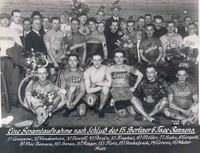
From 1926 to 1928, Walter Rutt, supported by Erich Kroner,
served as sports director for the Berlin Six Day Race.
In a six-day race, an average distance of 4,000 kilometers is covered. With a track length of 160 meters, as is the case at the Berlin Sportpalast, this amounts to 24,000 laps.
With the usual gear ratio, the cyclist covers approximately 7 meters with each double pedal stroke, meaning that 46 individual pedal strokes are required for one lap. Each team therefore pedals 1,140,000 times over the 24,000 laps, with each rider pedaling 552,000 times. Over half a million pedal strokes! If you were to ride these 4,000 kilometers of a six-day race in one direction, you would reach the North Pole to the north, Dahomey in Africa to the south, Tomsk in Siberia to the east, and the North American coast to the west.
Now a little about the costs of a six-day event. Apart from setting up the track, the daily allowances for the racers for all six days alone require 130,000 to 150,000 marks, with daily allowances ranging from 400 to 1,200 marks. Added to this are the special prizes for the winners and runners-up, lap bonuses, and travel and transport costs for foreign participants arriving by train and ship.
The ancillary costs sometimes amount to many thousands of marks, not counting the numerous “audience bonuses,” the value of which exceeds 30,000 marks in some races. The audience bonuses, whether cash prizes or material goods, offer a great earning opportunity for skilled bonus hunters. Of course, the number and amount of bonuses depends on the general business situation, so in bad times, when a superior bonus hunter is in the race, there is not much left for the others.
For example, at the penultimate Kaiserdamm race, I ended up with a box of cigars worth 7.50 marks, but in my heyday I was also able to take home many valuable and precious prizes. My most beautiful prize is a diamond pin offered by the former crown prince for a sprint, which I won at the time in a battle against the best foreigners, Americans and French, and against the best German cycle sprinters of the time.
Note The article appeared in 1925 in the magazine “Illustrierter Radrennsport” (Illustrated Cycling).