Collectibles 2
Postcard of the 1910 World Cup in Dresden
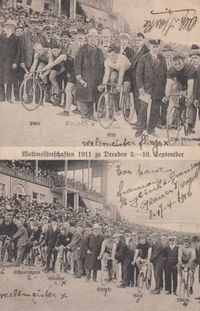
Cycling statistics list Rome, the Italian capital, as the venue for the 1911 World Track Championships. What took place in Dresden at that time has gone down in cycling history as the “unofficial World Championships.”
In 1910, there was a scandal at the World Championships in Brussels when Henry Mayer from Hanover finished a heat as the clear winner but was classified second by an Italian judge. In solidarity, all German riders withdrew from the competition and Germany soon after announced its withdrawal from the International Cycling Union (UCI).
The ensuing quarrels ultimately led to a defiant reaction from the Association of German Cycle Tracks. Under the leadership of Ferdinand Knorr from Berlin, an unofficial world championship was announced, which actually took place in Dresden-Reick in September 1911. A total of more than 50,000 spectators watched the first-class competitions. In the professional sprinters' final, Otto Meyer from Ludwigshafen prevailed over Walter Rutt and Oscar Peter.
Over the course of the following year, the quarreling parties reconciled “for the good of the sport,” and in 1913, Germany was awarded the official title fights as a gesture of reconciliation.
Publishing house: Franz Martin, Leipzig
Italian sports magazine
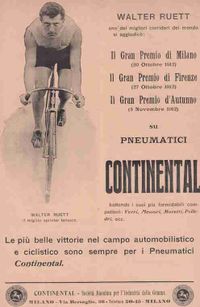
The tire manufacturer Continental equipped Walter Rutt's racing bike with tires for 24 years. This was advertised both domestically and abroad. The advertisement appeared in an Italian sports magazine, depicting “the best German sprinter.”
Newspaper clipping from 1912
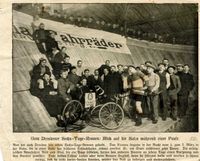
This small piece of paper is a valuable historical document, as it clearly describes the difficult conditions that six-day cyclists were exposed to at that time.
The text reads: "Dresden has now also had its first six-day race. The race began on the night of March 1 to 2 in the track, which was built in a hall of the former slaughterhouse, with ten teams appearing at the start. The successful racers Rutt and Stol, who formed a team, had given the other teams a three-lap lead each day. However, these two riders had bad luck during the race, as they both crashed and were so seriously injured that they could not think of getting back on their bikes to continue."
Medal from the Rutt Arena
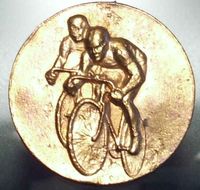
Walter Rutt always made an effort to promote young talent at his cycling track. A note in the magazine “Illustrierter Radrennsport” (Illustrated Cycling) from July 13, 1930, states, for example: “Walter Rutt will now be teaching his trainees at the Rutt Arena not only on Sunday mornings, but also on Wednesday evenings.”
The medal shown here was probably intended as an award for a junior race. Due to its simple design, it would not have been considered as a prize for a professional.
The reverse side shows a raised laurel wreath with the engraving “Rutt Arena 1st Prize” inside. At the top edge, you can see where an eyelet was attached to hold a cord. The medal has a diameter of 3 cm.
Through unknown channels, the medal later found its way to the USA, where I was able to purchase it through an internet contact.
Postcard of the Cologne velodrome
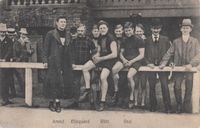
The motif for this postcard was created at the Cologne Riehl velodrome. Willy Arend, Thorvald Ellegaard, Walter Rutt, and Jon Stol interacting with fans.
Photo: Otto Spenke, Köln
Studio photography
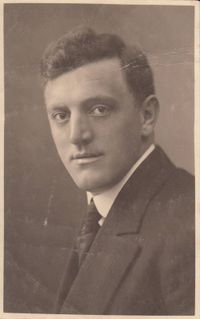
Photos of Walter Rutt taken in the studio are rare. Even rarer are photos of him in civilian clothing, such as the one shown here.
You can find private photos of the Rutt family from Peter Rütt's album here.
Photo: W. Wertheim, Berlin
Postcard from the 1904 World Cup
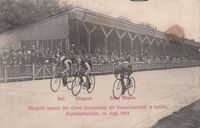
Close finish at the Crystal Palace velodrome in London.
Photo: Hochwohlgeboren Ohler, Köln