"Iron training and a solid lifestyle
were the reasons for my success."
The path to fame
On the advice of August Lehr, the 1894 world champion, Walter Rutt turned professional at the age of 17 and was soon one of the most popular cyclists in the Rhineland and then throughout Germany. His friendly demeanor, courageous riding style, and fairness were well received by the public.
He proved to be a worthy successor to Willy Arend, whose star was slowly fading, and showed no fear when he faced the international elite. After his first victories over Thorvald Ellegaard, Henry Mayer and Frank Kramer, he made his definitive breakthrough and in 1904, when he won the prestigious “Grand Prix de la République,” among other races, he was considered the best sprinter in the world.
Family happiness in Australia
In the same year, he married Charlotte Nord, the sister of Danish sprinter Orla Nord. In 1906, during a stay in Australia, the couple had a son, whom they named Oskar. Walter Rutt and Thorvald Ellegaard had been hired for several races and traveled to the fifth continent with their families. There, despite strong competition, the German was celebrated as the winner in nine out of ten races.
He later considered it a stroke of luck that he had “only” come second in the “Sydney Thousand,” the world's most lucrative cycling race. A victory would have earned him a lucrative contract and the prize money would have gone toward the purchase of an Australian hotel that he wanted to run himself. That would have been the end of his sporting career.
He had no communication problems abroad either, as he was fluent in English, French and Danish in addition to his native language.
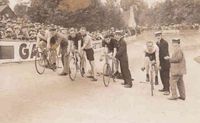
Photo: Elektra Paul Hoffmann, Berlin
Start of a sprinter's match in Treptow
A life out of a suitcase
Hardly a day went by without the cycling sprinters facing each other somewhere in Europe and fighting bitterly for the favor of the audience and high prize money. The participants traveled to the races exclusively by rail. A review in the “Illus” newspaper on June 9, 1929, illustrates the effort the professionals had to put in.
"On Friday, June 3, 1904, Walter Rutt defeated Frenchman Edmond Jacquelin in three races on the Buffalo track in Paris. That same evening, he boarded a train, arrived in Cologne on Saturday morning, continued on his journey, arrived in Hamburg in the evening, and landed in Copenhagen on Sunday morning, after a non-stop 36-hour train journey, where he had to compete in a match against Thorvald Ellegaard on the Ordrup track. The Dane, who was virtually unbeatable on his home track and also completely fresh, was easily defeated by the ambitious Rutt in two races."
Detailed reports on the competitions could be read in Germany in “Rad-Welt” a high-circulation magazine that appeared daily.

Start of a prominent-participant sprinter's race

Photo: Culver Service, New York
Walter Rutt and John Stol at the velodrome of Newark
Premiere in New York
Meanwhile, six-day races were experiencing a tremendous boom in the USA. The idea of having teams of two cyclists, who were allowed to take turns as they wished, race for 144 hours on a small track generated enormous interest and filled the halls. The American Floyd Mac Farland recognized Walter Rutt's ability to ride at high speeds over long distances and persuaded him to participate in the 1906 New York Six-Day Race. The German-American team achieved a respectable third place.
The following year, Walter Rutt – nicknamed “Bearcat” by his fans in the USA – achieved his first victory at Madison Square Garden alongside Dutchman John Stol and the newspapers were full of praise. In 1909 the team Rutt-Clark took the lap of honor, and in 1912 Joe Fogler won alongside the German.
“Rutt makes no distinction between victories. For him his self-esteem is satisfied when he crosses the finish line first and regardless of whether the ordeal lasts two minutes or six days, he only remembers the result achieved. He never looks for an excuse for defeat; he never overestimates a victory, no matter how brilliant it may be.”
This was the opinion of sports journalist Charles Ravaud at the time, who added: “Rutt is as strong morally as he is physically. I don't think we could find a more likeable, correct, and well-mannered cyclist at the moment.”
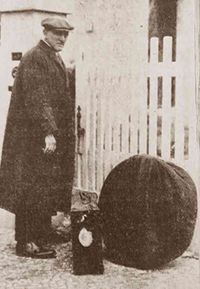
Photo: Illustrierter Radrennsport
Walter Rutt returning from a “business trip”
Celebrated in Berlin
In Berlin, where a six-day race was held for the first time in 1909, there was keen interest in signing Walter Rutt for the following year. He had been living in Courbevoie, a suburb of Paris, for four years because he had not fulfilled his military service obligations and did not dare to cross the German border for fear of arrest. His pardon was achieved through diplomatic channels.
The Berlin press reported exuberantly: "Walter Rutt has arrived! What had spread as a rumor during the Christmas holidays has become reality: the great Rhinelander has arrived to take up the fight on a German track against the advancing foreigners after many years. People still can't believe their eyes, but Rutt is ready to face the starter and later the military authorities. O noble Germany, rejoice, your Walter is bold and 'rutt'erlich."
Alongside Jack Clark, he not only won the 1910 event, but also the next three races on the Spree with John Stol. In 1911, the team also won in Frankfurt. Years later, Walter Rutt described his first Berlin six-day victory as the one that had touched him most emotionally.
On July 26, 1911, the British magazine “Cycling” reported that Walter Rutt intended to attack the world hour record, which at the time was held by Frenchman Marcel Berthet with 41.520 km. It probably remained just an intention, as the Rhinelander's name is not mentioned anywhere in the relevant statistics.