The Rutt Arena
Before ending his career, Walter Rutt considered how he should shape his life in the future. As an “unskilled” person who had dropped out of school at the age of 17 to become a professional cyclist, the only option for him was to continue working in this field.
The cycling track in Cologne-Riehl, which had been closed for a season, seemed like a worthwhile project to take on as an organizer. He negotiated a lease with the owner, Baron Oppenheim, but the two parties were unable to reach an agreement. He therefore decided to build a small wooden training track in Berlin's Hasenheide park, where standing room would cost only 50 pfennigs.
In March 1926, American promoters Mihlon and Chapman, who controlled all racetracks in the USA, were in Paris, and Walter Rutt happened to hear about it. The very next day, he took the train to the French capital to meet the two men. Chapman and Mihlon were enthusiastic about his plans and drew up the exact dimensions of the Newark track for him. Frank Mihlon provided $25,000 for the construction. At the time, this corresponded to a sum of 100,000 marks. The Elbe and Ludwig company was commissioned to carry out the construction.
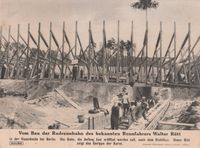
Photo: J.J. Weber Leipzig
The construction of the velodrome
Excavation work began in April 1926, and 1,200 concrete blocks were cast on site to form the foundation for the velodrome.
Construction was already in full swing when serious problems arose. The first batch of wood delivered for the substructure of the track was rotten and had to be replaced. Shortly thereafter, the responsible authorities even imposed a construction freeze. Opponents of the velodrome had mobilized against the “disfigurement of valuable green spaces” and demanded the preservation of Hasenheide out of supposed “fear of an American fairground.”
However, the real reasons for the protest by the Neukölln district councilors were that the police, who owned the land, had so far refused to make the site available for other purposes.
The speed with which the work was carried out is remarkable. Less than three months passed between the felling of the first trees and the opening of the track.
A name is being sought
In May 1926, an advertisement appeared in Berlin's major daily newspapers asking readers to submit suggestions for a name for the velodrome that was under construction. It was expressly stated that the words “Rutt,” "World Champion and “Hasenheide” were not to be included in the name, which was to be short and memorable. The newspaper advertisement also pointed out that a touring bike would be raffled off among all entrants.
Several thousand entries were received, and most of them expressed the opinion that, contrary to the world champion's original intention, the name “Rutt” should definitely be included in the name. The jury therefore decided on the name “Rutt Arena.”
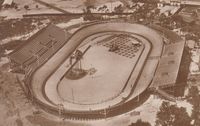
Photo: Rutt Arena GmbH
Aerial view of the Rutt Arena
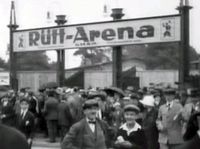
June 27th. 1926 Opening of the Rutt Arena
The opening of the Rutt Arena
On Sunday, June 27, 1926, the Rutt Arena was opened, even though it was by no means complete. Among other things, the curved grandstands were still missing. The celebrations began with a parade of all the district clubs led by their banner bearers, and the opening speech was given by Federal President Dr. Totscheck-Stettin. Former champion Leinert rode a lap on a penny-farthing before the track was opened for the Berlin district championships.
In the weeks that followed, the Rutt Arena grounds became a hive of activity, hosting not only the elite of international professional cyclists, but also junior races and training courses. Public race days were held, as were the Berlin Newspaper Delivery Championships, boxing matches, and a competition for market traders.
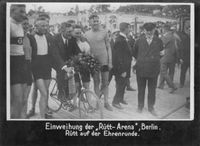
Walter Rutt completes a lap of honor
Since spectators were no longer attracted solely by sprint races, expensive six-day team races were also held, and renowned stayers were hired to ride behind small pacemakers.
During the winter months, parts of the interior were converted into an ice rink, and entertaining events were held in the facility's restaurant.
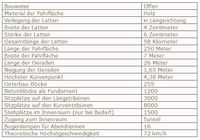
Technical data for the Rutt Arena
A pub in Berlin
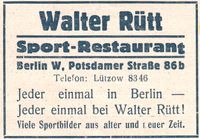
In November 1929, Walter Rutt opened a small pub on Potsdamer Straße, in the immediate vicinity of the Sportpalast. This venture was intended as a second source of income.
However, the restaurateur's son found it difficult to deal with guests. In addition, the premises were not very inviting; the bar area with its vaulted ceiling had an almost sacred character. The “Sport-Restaurant” was not profitable and only lasted a short time.