The fire at the Rutt Arena
The bad weather becomes proverbial
The Rutt Arena hosted some fantastic events in beautiful weather and to sold-out crowds. However, it rained very often and the races took place in front of empty stands or were canceled altogether. Walter Rutt still had to pay the expensive foreign cyclists' expenses and, out of fear, moved the races to two or three days. Additional accommodation expenses were incurred, the races were rained out again, and so, in addition to handsome surpluses, there were also huge deficits.
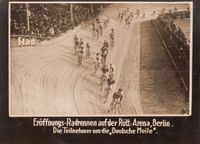
Race at the Rutt Arena
A typical report in the Neuköllnische Zeitung newspaper on June 1, 1930 read: "As the races were about to begin yesterday at the Rutt Arena, a thunderstorm poured down, completely flooding the wooden track; a little later, there was another downpour, destroying all hopes that the race might still take place, albeit with a delay. The races are now scheduled to take place today at 8:15 p.m. As is well known, the 5th race of the German Sprint Championship and a 50-kilometer team race will be held. Tickets already purchased remain valid."
A popular saying in Berlin was: “If you want to know what the weather will be like, ask Rutt if he's racing.”
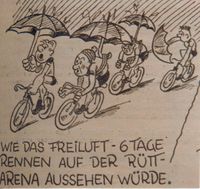
Cartoon about the bad weather at Rutt Arena
In financial distress
In July 1930, the situation at the velodrome came to a head. Walter Rutt himself was now only acting as sporting director, all other powers having been taken away from him by his business partners. His last savings had been used up and he had mortgaged his small country house in Lankwitz.
Frank Mihlon had long since refused to provide further funds; he had invested a total of more than 150,000 marks in the company and had already written off this money. Director Koplowitz, now responsible for the commercial side of the business, had also invested huge sums of his own money and did not want to take any further risks.
On race days, creditors lined up at the Rutt Arena office to assert their claims. Some German cyclists agreed to guarantee the races could continue by pledging their fees. The revenue was to be used first to cover the running costs for advertising, music, inspectors, taxes, and the fees of foreign cyclists. Any surplus would go to the Rutt Arena to cover all liabilities.
The Rutt-Arena is on fire!
On Sunday, May 3, 1931, the sky was bright blue—after all, it wasn't a race day—when a fire broke out in a storage room under the grandstand, spreading like wildfire throughout the entire facility. The fire department had to bring water from far away, but their efforts were ultimately in vain, leaving only smoking ruins behind.
The enormous heat caused all the windows of an old railway carriage, which Walter Rutt used as a lounge, to shatter. The fire also destroyed the racing equipment of several professional cyclists and Germany's best two-seater, a “Panther tandem” built in 1906, a relic from the glory days of the world champion. The operator of the restaurant was hit hard, losing all his possessions. The following night, looters raided the scene of the fire and stole benches from the interior and canned food from the basement.
Walter Rutt, who had run into a fence while fighting the fire and suffered serious injuries to his face, experienced the darkest hours of his life here. The work he had put his heart and soul into was destroyed, leaving him financially ruined. To make matters worse, the insurance company had canceled the policy because of the high risk, as five other wooden tracks had burned down in a short period of time.
The cause of the fire could never be determined with certainty, but the following assumption is considered the most likely.
On the morning of the day of the accident, Berlin police officers were training their sheepdogs on the grounds of the velodrome. Shots were also fired to accustom the dogs to the sound. Later, the heavy coats worn by the officers were hung in the storage room under the track. A pistol was in one of the coat pockets, and its hot barrel is believed to have ignited the coat.
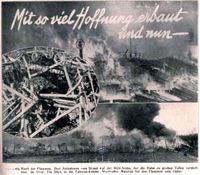
Photo collage on the cover page
“Illustrated Cycling”
Velodrome Hasenheide
A few weeks after the fire at the Rutt Arena, there were reports in the Berlin press about a possible reconstruction of the facility. Cyclist Lothar Ehmer was named as the initiator of this campaign, and Max Münzner from Berlin, who had already organized races at the Sportpalast, was to act as its director. Negotiations with the former managing director of the Rutt Arena, Dir. Koplowitz, were reportedly underway, and the Wilmersdorfer Baugesellschaft (formerly Elbe&Ludwig) had been asked to provide a cost estimate.
The grandstand on the opposite straight, which was still intact, was to serve as the main grandstand, and the track length of 250 meters was to be retained. The new name for the velodrome under discussion was “Velodrome Hasenheide.” Unfortunately, all efforts came to nothing.