How I experienced the fire at the Rutt Arena
By Walter Rutt
May 3, 1931, was an exciting day. I was at the track at 10 a.m. to lead my training school for the first time this year. The weather was wonderful, the students were eager, there were new faces and old acquaintances, and everyone wanted to succeed this year and become skilled drivers. The races were stopped earlier than usual because a police dog club wanted to have a few dogs jump over hurdles in the indoor arena. Around noon, things quieted down at the track.
The spectators had dispersed, the cyclists hurried off to lunch, and the dogs were no longer to be heard. Only a few acquaintances remained at the track. We eat lunch, visitors arrive, everything is peaceful, and we enjoy the beautiful weather. But we can't have coffee outside because it's too windy. So we sit in my old, discarded railway car.
Someone suggests a game of chess, and we start playing. Then the zeppelin arrives, but it has a hard time fighting the strong wind. The airship has long since disappeared from view when someone comes running from the cabin yard: “Quick, quick, there's a fire behind the curve.”
I run as fast as my legs can carry me to the cabin yard and see smoke rising from the equipment shed and fire between the cracks in the boards. I quickly run to the telephone, 20 steps away, and alert the fire department, then return to the scene of the fire. About six young men are trying to pour water from buckets from the water pipe five steps away onto the source of the fire. We have to go into the room because that's where the fire extinguishers are located for connection to the nearest above-ground hydrant.

"Illustrierter Radrennsport"
Someone breaks down the door with an axe, but this suddenly gives air to the fire, which must have been smoldering for several hours. A large jet of flame shoots out and instantly the fire, which had been confined until now, bursts into life. It spreads wildly in all directions. The heat becomes so intense that we have to flee. It is now impossible to get any closer to the scene of the fire. The fire department must be here any minute; you can already hear them. I stare at the entrance to the racetrack, where they should be arriving any moment, but they are not coming from there.
Instead, the firefighters are running over from the neighboring property and laying a hose several hundred meters long in a rather cumbersome manner. By the time the water finally arrives, the cabin yard has caught fire. The strong wind is helping the fire to spread quickly.
A higher alarm is raised and now, unfortunately, it turns out that the next steam pump connected to another hydrant does not provide enough water because the first pump is taking all the water from the second. The fire spreads from the cabin courtyard to the restaurant, the large toilet facilities catch fire, and the curve is ablaze. And not a drop of water!
Finally, the grandstand and the restaurant hall behind it are on fire. At last, the fire department arrives from the other side, and within a few minutes, the fire is brought under control. By then, more than an hour had passed, and 14 kilometers of hose had been laid. Unfortunately, the fire department was unable to use the above-ground hydrants at the racetrack, three of which are located around the track and were very expensive to install, because the motor pump took all the water from this ring main. This was the only reason the fire was able to spread so far.
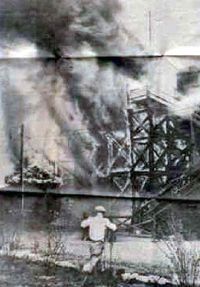
Newspaper photo of the fire at the Rutt Arena
The German building authorities and fire department have never been fond of wooden tracks. After the fire, it was interesting to note that the actual racetrack, i.e., the driving surface, had suffered relatively little damage. Forty meters on the long side close to the completely burned-out grandstand remained completely intact. The closely spaced slats acted like a giant board, with nowhere for the fire to take hold, and while the huge grandstand pillars close to the track lay completely charred on the ground, only the first slat of the track was slightly charred.
This proves that wooden tracks are very difficult to set alight by sparks from pacemaker machines or exploding petrol tanks. This fire also had another sad consequence. On the very first night, everything that could be stolen was stolen: the innkeeper's canned goods from the cellar, my garden bench, a giant advertising umbrella, various items belonging to the trackman, and five young people were caught at 5 a.m. trying to divide up unusable racing machine parts by the light of a lantern.
They had stolen the most useless things, but they had stolen and will not escape punishment. The cause of the fire is still unclear at this time. The most likely scenario is that a heavy coat caught fire from cigarette butts or from the use of a revolver and was then hung in the equipment shed. Police questioning is still ongoing.
Note
The report appeared shortly after the fire in the magazine “Illustrierter Radrennsport.”