Secrets of velodrome construction
By Architekt Clemens Schurmann und Walter Rutt
The extremely elegant mobility of the bicycle, which allows people to multiply their speed without a particularly large increase in effort, attracted competition from an early stage. The first automobile races, which were introduced at around the same time, were never seen as competition. On the contrary, they tended to increase interest in bicycle racing, because in the former it was the engine that did most of the work, while in the latter the rider had to rely on his own strength.
It was not without reason that in Germany the fast races over short distances at top speeds were given the name “aviator races,” because here the cyclist, without the assistance of other forces, reached speeds similar to those of a bird in flight. Over time, these speeds have been increased considerably through improvements in the technical details of the bikes and also through the creation of special tracks. The world record for the hour without a pacemaker was set in 1942 by the outstanding racer Fausto Coppi with 45.871 kilometers per hour on the fast Vigorelli track in Milan. Over short distances, considerably higher speeds of over 60 kilometers per hour are achieved.
The great interest in cycling among the general public led very early on to the construction of tracks with grandstands arranged around them, from which the races could be comfortably followed in all their details. The layout was always based on an oval shape, which varied in length depending on the space available, with slightly banked curves. In Berlin, such an oval asphalt track already existed in Hallense in the early 1990s, with curves that were slightly banked on the outside.
However, as the asphalt surface softened in strong sunlight, concrete was soon adopted as the building material, but the solid foundation required for this took time and was quite expensive, so experiments were soon carried out with wood as a building material, which proved to be quite successful. Despite the humid climate in the Lower Rhine region, the open track in Duisburg, for example, remained in perfect condition for 24 years.
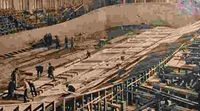
Construction of the velodrome in the hall at Berlin's Funkturm
Two developments were of great significance for the evolution of track construction. Firstly, the replacement of the multi-seater guide originally used in endurance races by motorcycle pacemakers, and secondly, the creation of covered winter tracks. In addition, the higher speeds made it necessary to increase the banking of the curves, and the indoor tracks (winter tracks) forced builders to construct shorter but faster tracks in order to keep the cost of the indoor facilities down.
Today, a track length of 333.33 meters is considered ideal because three laps are exactly one kilometer long. Very often, however, the available dimensions are not sufficient for such a length, and it is then a matter of track construction to create a facility that adapts to the given dimensions and still allows for flawless sport and top performance. The new Berlin track at the radio tower is only 153.8 meters long and allows speeds of over 44 kilometers per hour.
Basically, concrete and wood are considered suitable materials for track construction, although only wood is suitable for indoor tracks, while concrete is usually used for outdoor tracks. Really good cement tracks are more expensive than wooden tracks and also require a longer construction time, as the curves require either carefully constructed abutments or very firm soil to prevent cracks from forming. If a cement track is to be fast, the concrete must also be carefully processed.
The wide boards laid across the direction of travel in the early days have been abandoned, as the numerous butt joints led to vibrations in the machines and thus to speed losses, but even wide boards laid long ago proved to be unsuitable, as the individual boards easily warp, so that the track surface is no longer completely smooth and level. Today, the track is made of individual narrow slats.
To avoid nails in the surface of the track, these slats are nailed together sideways to form a closed block in the curve. On the long sides, they are nailed together to form panel packages to facilitate removal and then bolted firmly to the supporting substructure. This results in a solid, parquet-like track made entirely of wood, which can be adapted very precisely to the calculated shape and is also easy to dismantle.
The calculated shape is, of course, one of the essential prerequisites for a good track. This primarily concerns the curves and their entrances and exits into the straights. In open tracks, the straights are generally six to ten meters wide, and in indoor tracks, five to six meters wide, not including the carpet, which is the neutral transition to the interior, usually painted dark, that connects to the bottom.
It has proven useful to give the straights a very slight camber, even though no centrifugal force is exerted on them, ranging from about 6 degrees for long straights to 13 degrees for short straights. The purpose of this camber in the straights is to make it easier for cyclists to transition into the subsequent curve or exit the curve into the straight.
However, the design of the curves themselves remains crucial to the ride characteristics of the track, whereby a distinction must be made between the base and the elevation (cross-sectional profile). The semicircular layout of the first tracks was very quickly abandoned because the sudden transition from the straight to the curve was too abrupt and therefore felt almost like a jolt.
After testing many different basic shapes, the basket arch proved to be the most suitable, which is also used for toboggan runs. The basket arch shape inserts a transition curve between the straight line and the main part of the curves, resulting in a smooth and virtually shock-free transition.
The curve profile in cross-section poses far greater difficulties. Here, the basic requirement is that the cyclist must be perpendicular to the track at any speed, as this is the only way to ensure smooth, fast cornering. The centrifugal force, which increases at higher speeds, requires a greater inclination of the track surface, as every cyclist knows when leaning into a curve. It is the art of the track designer to correctly measure this inclination in all parts of the curve.
While sled tracks use strongly concave curves, a straight curve profile has become the norm for cycling tracks, which only transitions into the flat carpet at its lower end with a short curve. As can be seen from the above, the slope of the track must of course be greater for faster endurance races with motor guidance than for slower sprinter and team races.
In order to be able to use the same track for both purposes, a combined facility has been created, whose curves are flatter in the lower part and more steeply sloped in the upper part, which is connected by a short curve. We believe that this type of curve, which has proven itself in bicycle racing, also has considerable advantages for luge tracks, making it superior to the previous parabolic embankment.
It is interesting to note that there are even bicycle tracks with reverse curve profiles, i.e., with a cross-section that curves outward. This design has practically no particular advantages.
For the calculation of the curve profiles in detail, maximum speeds of approximately 65 kilometers per hour, as driven on the last 200 meters, should be used as a basis for individual and team races, and 100 kilometers per hour, as measured in combat arenas, for endurance races with motor guidance. It should be noted that the exit of the curve must be higher than the corresponding point at the entrance.
The track is constructed in such a way that first, the ground plan of the inner edge of the track is “marked out” on the hall floor according to the plans and “flocked” into the ground. The track blocks, which are made elsewhere from square timber, are then placed in the appropriate positions. The upper part of these blocks, which will later support the track, must be constructed exactly according to the drawings, as this determines the shape of the profile. In this way, the blocks already form the exact profile without any reworking being necessary.
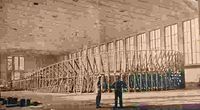
The skeleton of the velodrome in the hall at Berlin's Funkturm
The vertical superelevation of the curves varies between four and six meters for radii between 13 and 35 meters and has a gradient between 45 and 60 degrees. If stayer racing is to be considered, the larger radii and steeper gradient as well as the greater superelevation must be selected in order to counteract the greater centrifugal force resulting from the higher speed and mass. When using a wooden track, the track surface is also reinforced.
This brief description of some of the issues that arise in the construction of cycling tracks already shows that the designer must have thorough knowledge of very different areas of technology. That is why not many architects can deal with these matters. Without practical racing experience of one's own, track construction is hardly possible at all.
Source reference: "Natur und Technik" Nr. 22 1949 Wedding-Verlag-Berlin